24-Hour Blood Pressure Patterns: Understanding Your Daily Rhythm
Blood pressure is not a fixed number — it follows a 24-hour cycle shaped by sleep, waking, meals, and activity. Understanding this rhythm transforms raw readings into meaningful personal data.
If you've ever compared a morning blood pressure reading with one taken in the afternoon or evening, you know the numbers can look quite different. That variation isn't a sign of a problem — it's a reflection of a well-documented daily rhythm that affects everyone.
Blood pressure naturally rises and falls throughout the day and night, driven by hormonal shifts, nervous system activity, physical effort, and even the simple act of waking up. When you understand this 24-hour pattern, individual readings stop being confusing or alarming and start becoming pieces of a larger, more informative picture.
This article walks through the key phases of the daily blood pressure cycle, explains what each phase means for your readings, and shows how consistent tracking over time reveals patterns that a single measurement never could.
The 24-Hour Blood Pressure Cycle
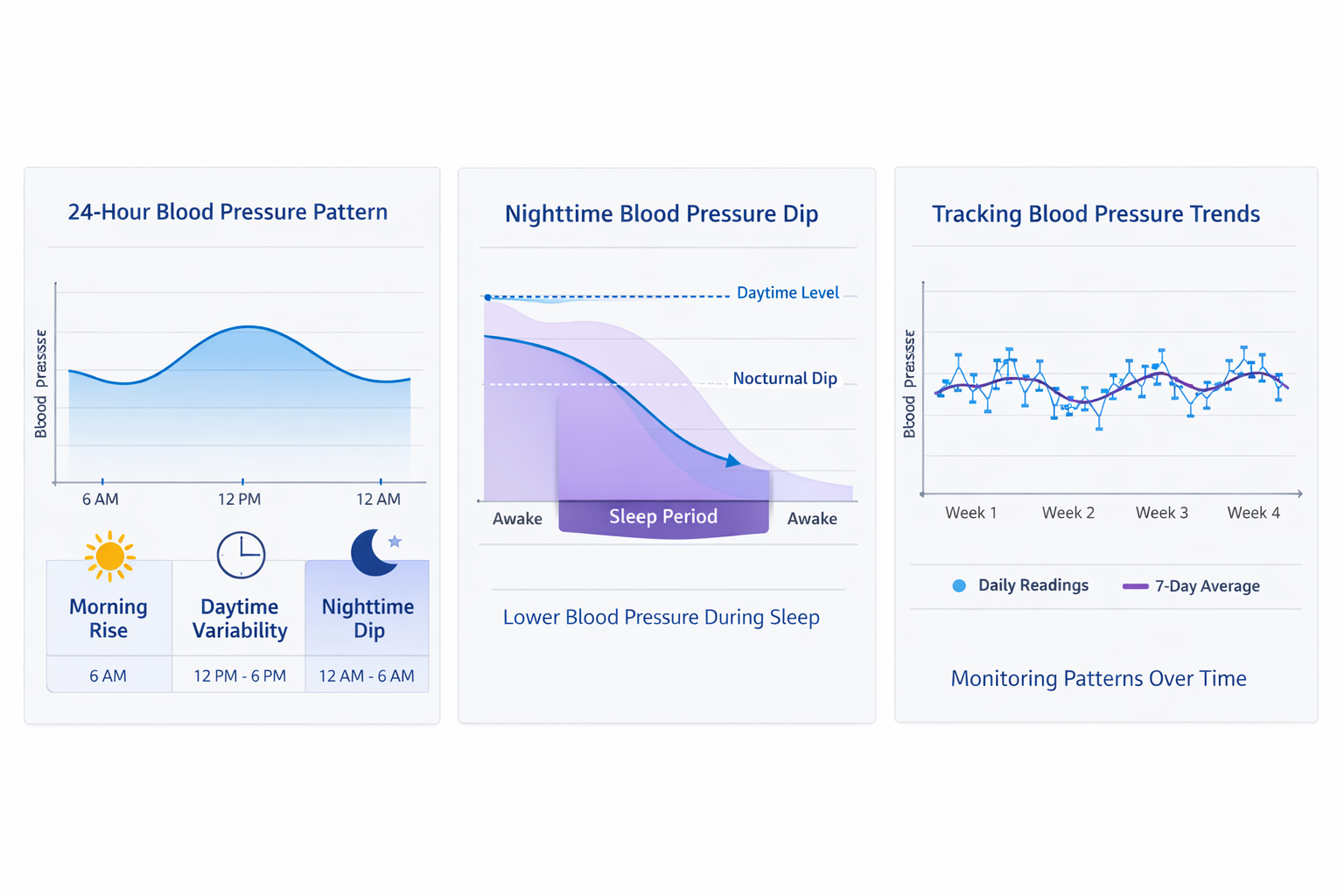
Blood pressure follows a circadian pattern that has been extensively studied. In broad terms, the cycle looks like this: during sleep, blood pressure drops to its lowest levels. As morning approaches, it begins to rise — sometimes quite sharply. Throughout the day, it fluctuates in response to activity, meals, emotions, and posture. In the evening, it gradually begins to decline again, preparing the body for sleep.
This pattern is driven primarily by the autonomic nervous system and hormonal rhythms. Cortisol, often called the "stress hormone," peaks in the early morning and plays a significant role in the morning rise. The sympathetic nervous system — the body's "alert" system — becomes more active during waking hours, while the parasympathetic system — the "rest and restore" branch — takes over during sleep.
Understanding this cycle is the foundation for interpreting any blood pressure reading. A number taken at 7 AM and a number taken at 9 PM are not directly comparable unless you understand the context each time of day provides.
Morning Rise: The Wake-Up Surge
One of the most consistent and well-studied features of the 24-hour blood pressure cycle is the morning rise. As the body transitions from sleep to wakefulness, blood pressure increases — sometimes significantly. This surge is triggered by the release of cortisol, activation of the sympathetic nervous system, and the physical transition from a lying to a standing position.
For many people, the highest blood pressure readings of the entire day occur within the first one to two hours after waking. This is entirely normal and expected. It reflects the body's preparation for the physical and mental demands of the day ahead.
Tracking Tip
Because the morning window captures this natural peak, readings taken during this time are particularly valuable for tracking. They provide a consistent reference point — as long as you measure at roughly the same time each morning, before coffee or food, and after a few minutes of sitting quietly.
Daytime Variability: The Active Hours
During waking hours, blood pressure is anything but static. It responds dynamically to virtually everything you do: walking up stairs, eating a meal, having a stressful conversation, drinking water, sitting at a desk, or exercising. Readings taken at noon may differ from those taken at 4 PM simply because of what happened in between.
This variability is normal and healthy. It reflects a cardiovascular system that is responsive and adaptive. The body adjusts blood pressure in real time to match the demands being placed on it — increasing flow during exertion and moderating it during rest.
For tracking purposes, daytime readings are most useful when accompanied by context notes. Logging what you were doing before the reading — whether you just ate, exercised, or were sitting quietly — helps explain day-to-day differences and prevents unnecessary concern about normal fluctuations.
The Nighttime Dip: Recovery During Sleep
One of the most important features of the 24-hour blood pressure cycle is the nocturnal dip — a natural lowering of blood pressure that occurs during sleep. For most people, blood pressure drops by approximately 10–20% compared to daytime levels. This dip reflects the body's shift into a restorative state, where heart rate slows, muscles relax, and the parasympathetic nervous system dominates.
The nighttime dip is considered a healthy sign. It indicates that the cardiovascular system is responding appropriately to the reduced demands of sleep. The body uses this period for repair and recovery, and the lower blood pressure during sleep reduces the overall workload on the heart and blood vessels over a 24-hour period.
Awareness of the nighttime dip helps you interpret evening readings in context. If you measure blood pressure shortly before bed, you may notice readings that are somewhat lower than your morning or midday values — and that's exactly what should happen.
What Your Patterns Can Tell You
When you track blood pressure at consistent times over days and weeks, patterns emerge that are invisible in any single reading. You may notice, for example, that your morning surge is more pronounced on workdays than on weekends, suggesting that anticipation of the day's demands plays a role. Or you might observe that your evening readings are consistently lower on days when you exercised.
These personal patterns are uniquely yours. Population averages and general guidelines provide a useful framework, but your own data — collected consistently over time — tells a more specific and actionable story. It's the difference between reading about weather patterns in general and checking the forecast for your exact location.
Some of the most valuable observations come from comparing the same time slot across different days, rather than comparing different times within a single day. Your Monday morning reading compared to your Tuesday morning reading reveals day-to-day stability or variability. Your Tuesday morning reading compared to your Tuesday evening reading shows your daily range.
Tracking Trends Over Time
Individual readings are snapshots. They capture a single moment, influenced by whatever was happening right before and during the measurement. Trends, by contrast, tell a story. A 7-day rolling average smooths out the natural variability of daily readings and reveals whether your blood pressure is stable, gradually shifting upward or downward, or responding to changes in habits.
Weekly and monthly trend views are far more informative than any single measurement. They help you see the forest rather than the trees. If your 7-day average has been steady for months and then begins to shift, that shift carries far more meaning than any individual high or low reading taken on a single day.
This is why consistent logging matters so much. You don't need to measure five times a day — but measuring once or twice daily, at the same times, creates a dataset that becomes increasingly valuable over time. After a month of consistent tracking, you'll have a personal baseline. After three months, you'll see seasonal patterns and responses to lifestyle changes with real clarity.
Building a 24-Hour Tracking Routine
The most effective tracking routine is one that is sustainable. For most people, that means measuring twice daily: once in the morning, within 30 minutes of waking, and once in the evening, before bed. Morning readings capture the peak of the daily cycle; evening readings capture the wind-down.
Measurement Preparation
Before measuring, sit quietly for at least three to five minutes with your feet flat on the floor and your arm supported at heart level. Avoid caffeine, exercise, and smoking for at least 30 minutes before a reading. These simple preparation steps dramatically improve the consistency and reliability of your data.
Equally important is logging context. A brief note — "after a 30-minute walk," "stressful meeting at work," "slept poorly" — turns a raw number into a data point with meaning. Over time, these notes help you identify which factors influence your readings most.
Why Understanding Your Daily Rhythm Matters
Awareness of your personal 24-hour blood pressure pattern helps you interpret every reading you take. A reading that seems high in the evening might be perfectly typical for your afternoon pattern. A lower-than-usual morning reading might coincide with a particularly restful night of sleep. Context transforms numbers into understanding.
More importantly, tracking over time gives you a sense of what is normal for you specifically. This personal baseline is far more useful than comparing any single reading to a population average. When you know your pattern, deviations from that pattern become visible — and visibility is the prerequisite for informed awareness.
The 24-hour blood pressure cycle is one of the most consistent biological rhythms in the human body. By aligning your tracking habits with this rhythm — measuring at consistent times, logging context, and reviewing trends — you transform raw data into a powerful tool for understanding your own cardiovascular patterns.
Discover Your Daily Blood Pressure Pattern
Start tracking your readings at consistent times to uncover your personal 24-hour blood pressure rhythm. Morning and evening logs, paired with context notes, create a rich dataset that reveals patterns over time.
Important Medical Disclaimer: LogMyVitals is a health tracking tool designed to help you monitor and log your vital metrics such as blood pressure, blood sugar, and weight. This platform is NOT a substitute for professional medical advice, diagnosis, or treatment. The information provided should not be used to diagnose or treat any health condition. Always seek the advice of your physician or other qualified healthcare provider with any questions you may have regarding a medical condition. Never disregard professional medical advice or delay seeking it because of something you have read or tracked on this platform. In case of a medical emergency, call your doctor or emergency services immediately.